From The Manhattan Transcripts to the Digital Portfolio: What Gets Lost in Representing Architecture?
What Bernard Tschumi's Manhattan Transcripts can teach us about architectural representation, and what gets lost when a project becomes an online portfolio.
Architecture has never been represented through a single image
In The Manhattan Transcripts (1976–1981), Bernard Tschumi explored a question that remains relevant to how we communicate architecture: how can a drawing represent more than the physical arrangement of space?
Tschumi brought together photographs, architectural plans, and movement notation. Each represented a different dimension of architecture. Drawings described spatial conditions, photographs witnessed events, and diagrams traced the movement of people through space. Rather than producing a single, complete image of architecture, the Transcripts examined the relationships and sometimes the contradictions between space, movement, and events.
His work challenged the limits of conventional architectural representation. A plan could describe the organization of a building, but not necessarily the events taking place within it. A photograph could capture a moment without explaining the spatial relationships surrounding the event. The meaning of architecture emerged through the relationship between representations.
The Manhattan Transcripts were theoretical investigations, not proposals for how architects should build their portfolios. But the questions raised by Tschumi become interesting when we consider how architectural work is presented online today.
Architects still spend considerable time selecting drawings, arranging diagrams, and determining the sequence through which a project should be understood. We use different representations because we know a photograph cannot communicate everything. Yet when the same project reaches a browser, the presentation often becomes a series of photographs, a project title, and a short description. Somewhere between the architectural presentation and the browser, much of the reasoning behind the work disappears.
What does a photograph leave outside the frame?
Architectural photography has an extraordinary ability to communicate the atmosphere. A well-composed photograph can reveal material qualities, relationships between light and surfaces, and the character of a space in a way that technical drawings rarely can. Photography also provides an accessible introduction to architecture for people unfamiliar with architectural conventions.
But the photograph is always a selection. The camera establishes a viewpoint, frames particular relationships, and excludes others. The resulting image might communicate the qualities of a finished space while leaving the decisions that produced those qualities unexplained.
Consider a renovation project. An interior photograph might show a beautifully resolved space, but the image alone may not reveal the existing structural constraints, the negotiation between old and new, or the sequence of decisions that made the intervention possible. A landscape photograph might communicate the atmosphere of a site without showing how grading, drainage, planting, and circulation work together.
Even a particularly successful architectural solution can remain almost invisible when its value lies in resolving a difficult condition rather than producing a striking visual moment.
Architects understand these distinctions because we are trained to read between different forms of representation. We can move from a photograph to a plan, recognize spatial relationships, and reconstruct aspects of the design process. A visitor considering an architect for a future project may not have the same familiarity with drawings or the same ability to infer design intentions from a photograph. The work can be compelling without its relevance being immediately understood.
The difference between seeing a space and experiencing architecture
In The Eyes of the Skin: Architecture and the Senses, Juhani Pallasmaa questions the dominance of vision in architectural culture. Pallasmaa argues for an understanding of architecture grounded in the relationship between the body, the senses, memory, and spatial experience. His critique becomes particularly relevant in a culture increasingly saturated with digital images.
We do not experience a building as a single visual composition. We encounter spaces through movement and duration. Our understanding changes as we approach an entrance, move through a threshold, experience a transition in light, or recognize the relationship between successive rooms. Materiality, sound, temperature, and scale contribute to an experience that cannot be fully captured in a photograph.
A website cannot reproduce those physical conditions either. Adding animations, interactive drawings, or video does not make a digital representation equivalent to inhabiting architecture. But recognizing the limits of digital representation raises a more productive question:
If a website cannot reproduce the experience of architecture, how can it help someone understand the qualities that a photograph alone cannot communicate?
The answer does not necessarily involve adding more images or more complex interactions. Sometimes the missing information is a plan. Sometimes a simple diagram explains the relationship. In other situations, a carefully chosen sequence of photographs or a few sentences about an important design decision may be enough. The challenge is to choose the representation appropriate to the architectural idea.
Architectural representation has always shaped how work is understood
In Privacy and Publicity: Modern Architecture as Mass Media, Beatriz Colomina examines how modern architecture developed in relation to photography, publications, exhibitions, and other forms of mass media. Her argument challenges the assumption that architectural media merely document buildings after they are designed. Representations participate in how architecture is communicated, interpreted, and understood within a larger culture.
The relationship between architecture and its image is therefore not a problem introduced by websites. Architects have long worked with publications, photographs, drawings, and exhibitions to communicate their ideas beyond the physical boundaries of a project.
Today, a firm’s website has become another important setting for this communication. The difference is that a digital interface offers ways to organize information that are not limited to a fixed sequence of printed pages or individual photographs. A visitor can move between representations, compare conditions, explore relationships, and follow a particular question about a project.
But these possibilities are not automatically meaningful. A portfolio with more interactive elements does not necessarily communicate more architecture. The method of presentation needs to emerge from what the project requires someone to understand.
Bring the thinking behind architectural drawings into the digital experience
In architectural practice, we rarely explain a project through one drawing. We compare plans and sections, overlay existing and proposed conditions, isolate systems, and develop diagrams to clarify relationships that would otherwise remain difficult to see. These methods are fundamental to architectural communication because they allow us to make particular aspects of a project legible.
Yet online portfolios often separate related information into disconnected images. A visitor scrolls through a photograph, encounters a drawing several images later, and has to reconstruct the relationship between them. There may be a more appropriate way to present certain projects.
Keeping spatial relationships visible
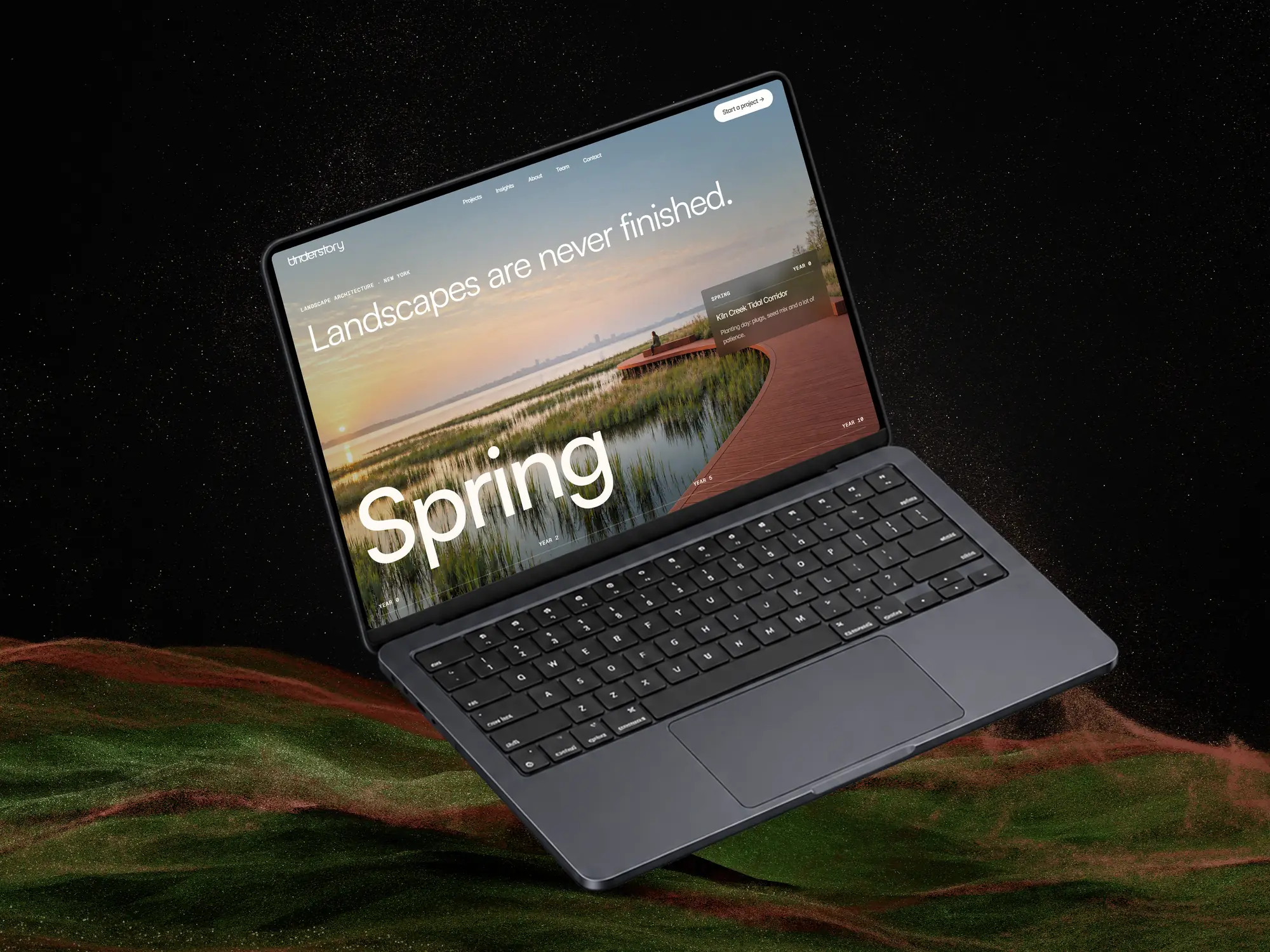
For our Understory landscape architecture website concept, we explored how photography, drawings, and overlays over time could be connected within a consistent project view. Rather than treating each representation as a separate image, the interface allows visitors to switch between different layers of information while maintaining their spatial reference. The approach draws from familiar architectural presentation methods.
For a landscape project, comparing representations in a shared view might reveal how circulation responds to topography, how planting strategies relate to existing site conditions, or how proposed interventions operate within a larger ecological system. For an adaptive reuse project, a similar approach could clarify the relationship between an existing structure and a new architectural intervention.
The purpose is not to make a project more interactive for its own sake. The purpose is to preserve a relationship that becomes harder to understand when the information is separated.
Giving details enough context to communicate their significance
In our LintelIn interior design website concept, we explored another approach: allowing visitors to discover selected architectural and interior details directly within a photograph.
Imagine presenting an interior project to someone in person. You might point to the transition between two materials, explain how a custom object relates to the room, or describe why a particular detail matters to the overall design. The explanation changes what the person notices. A photograph presented without context may not communicate those relationships, even when the details are clearly visible.
For LintelIn, we explored interactive annotations that introduce selected elements within an interior image. Visitors can explore the details while keeping the larger spatial composition in view. Rather than replacing the photograph, the interaction provides another way to read the space.
Neither approach should become a universal prescription for architecture websites. Some projects benefit from a sequence of static diagrams. Others need only a photograph paired with a precise explanation. An elaborate interface can become an obstacle when the information is straightforward. The architectural content should guide the medium, not the other way around.
A project should communicate more than the finished appearance
The value of presenting architectural reasoning extends beyond helping visitors understand individual projects. A practice’s portfolio also communicates what the firm knows how to do.
Consider two architecture studios presenting projects of similar scale and quality. One website emphasizes completed photographs. The other makes selected aspects of the design process visible: how the team responded to an unusual site, negotiated a structural limitation, or organized spaces around competing requirements. Both may demonstrate design ability. But the second presentation can also help visitors understand the kinds of problems the practice is equipped to solve.
For prospective clients, such distinctions can be important. A developer evaluating an architect for a complex renovation may be more interested in the firm’s judgment about existing conditions than in finding a photograph that looks exactly like the proposed project. Someone planning a residential commission may want to quickly understand how the architect approaches privacy, natural light, changing family needs, or the relationship between interior spaces and the landscape.
The most relevant evidence may already exist in the architect’s work, but remain difficult to discover through photographs alone. Architectural reasoning becomes part of how a practice communicates its expertise.
This does not mean every project page needs to become a comprehensive case study, the online storytelling matters. A thoughtful introduction, an explanatory drawing, or a carefully selected comparison can provide enough information for visitors to recognize the relevance of the work. The goal is to make important design decisions understandable without requiring visitors to have architectural training.
What should an architecture firm’s website communicate?
Architecture websites serve different audiences. Other architects may be interested in the conceptual development of a project or the relationship between drawings and completed work. Potential clients are often looking for something different. They want to understand whether a practice’s experience, approach, and priorities make sense for their project. Collaborators may be searching for particular technical expertise, while prospective employees may want to learn how the studio operates.
These visitors do not necessarily need the same information or level of explanation. A website should make room for different ways of approaching the work.
For an emerging practice, this can be particularly valuable. A small portfolio may contain relatively few completed commissions, but each project can demonstrate substantial thinking, expertise, and ambition. A clearer explanation of the work can help visitors recognize those qualities.
And the website must still function as an accessible, usable digital experience. Drawings should remain legible across screen sizes. Interactions should work with keyboard navigation and not depend entirely on animation. Large images should load efficiently, and visitors should be able to find information without first learning an unfamiliar navigation system.
Architectural expression and digital usability are not opposing concerns. The most effective solution may be visually restrained, technically straightforward, and exceptionally clear.
Designing the presentation is part of communicating the architecture
At Omni2, our backgrounds span architecture, landscape architecture, digital product design, and development. Moving between these disciplines has made us particularly interested in what happens to architectural ideas as they move into digital environments.
We recognize the reasoning behind a section, a diagram, or a carefully arranged project presentation. We also understand the digital decisions involved in turning those materials into a usable experience. The overlap creates opportunities to reconsider conventions that architecture firms may have accepted simply because most websites use them.
A project does not always need to become a conventional image gallery. A firm’s website can be a place where photography, drawings, writing, and digital interactions work together to communicate the character and intelligence of the practice.
Tschumi’s Manhattan Transcripts remind us that no single representation can account for every dimension of architecture. Pallasmaa makes an equally important distinction between seeing architecture and experiencing it. Neither argument suggests that a website should attempt to contain the entire experience of a building. But both invite us to consider what we choose to represent and what remains absent.
Perhaps the more interesting question is not how many projects an architecture website can display, but how much of the architecture someone can understand through the way those projects are presented.
A photograph can invite someone into the work. A thoughtful presentation can help them understand why the work matters.
Common questions
- Can architectural photography alone communicate the full value of a project?
- Photography can communicate atmosphere, composition, materiality, and the character of a space remarkably well. But some of architecture's most significant achievements are relational rather than immediately visible. A project might be valuable because of how it negotiates existing conditions, accommodates different patterns of occupation, or responds to environmental constraints. When those decisions are important to the story, a drawing, diagram, or concise explanation can reveal qualities that photography leaves outside the frame. The objective is not to diminish photography, but to recognize where another representation adds understanding.
- How can an architecture website make complex drawings understandable to people outside the profession?
- The challenge is not necessarily to simplify the drawing itself, but to help visitors recognize what they are looking at and why the information matters. A plan may be unfamiliar to someone without architectural training, yet the relationship between an existing wall and a new opening can be explained through a carefully chosen comparison. A short description, a highlighted area, or a paired photograph can establish the necessary context. The most successful presentation preserves the intelligence of the architectural drawing while making its significance accessible to someone encountering the project for the first time.
- When do interactive features actually improve the presentation of architecture?
- Interaction becomes useful when the visitor gains an understanding that would otherwise be difficult to communicate. Comparing an existing condition with a proposed intervention, exploring different layers of a landscape strategy, or examining details within their larger spatial context can provide a reason for interaction. But complexity should not be mistaken for depth. If a static diagram communicates the relationship more clearly, adding movement or controls may only introduce unnecessary work for the visitor. The architectural question should determine whether interaction belongs in the presentation.
- How can an emerging architecture practice communicate its expertise with a limited portfolio?
- A small number of completed projects does not necessarily reflect a limited depth of architectural thinking. An emerging practice can use their portfolio to communicate the challenges they have addressed, the judgments they have made, and the kinds of work they hope to pursue. Rather than presenting every project with the same sequence of images, the practice can identify what each commission demonstrates about their approach. One project might reveal sensitivity to existing conditions, while another illustrates an interest in material experimentation or spatial organization. The strength of the portfolio comes from making those distinctions visible, not simply increasing the number of projects displayed.
- How can your architecture firm evaluate whether your website communicates your work effectively?
- A useful starting point is to observe what people understand after exploring the website, rather than measuring attention alone. Can someone unfamiliar with the practice explain what distinguishes your approach? Can a prospective client recognize which projects relate to their own needs? Can visitors identify the reasoning behind a design decision without requiring an architect to explain the work in person? Testing a few project pages with people outside the studio can reveal where important relationships remain unclear. For the practice, the larger question is whether the website helps the right audience understand its expertise and begin more informed conversations.
Sources
The arguments above draw on three texts on architectural representation and its relationship to media.
- 01Bernard Tschumi, The Manhattan Transcripts (1976–1981). See also The Museum of Modern Art’s collection.
- 02Juhani Pallasmaa, The Eyes of the Skin: Architecture and the Senses. First published in 1996.
- 03Beatriz Colomina, Privacy and Publicity: Modern Architecture as Mass Media. MIT Press, 1994.

Sherry Faryadi
Product designer at Omni2 Design, leading its product work and the marketplace. UPenn-trained architect. About the studio